SO we begin with the next phase, the next series of blogs. In the previous articles of this series, I have explored how gastrointestinal function, and indeed biological function more broadly, cannot always be adequately explained by studying organs, pathways or molecular mechanisms in isolation. We examined how physiology emerges from interactions between multiple regulatory systems, why disease may develop without obvious structural abnormalities, and how systems biology offers a more integrated way of investigating biological function and disease. This discussion gradually led us towards Ayurveda Biology, where concepts such as Agni, Ama, Dosha, Srotas and Koshtha were revisited in relation to biological regulation, adaptation, transformation and individual variability.
However, as we begin to move from conceptual discussions towards scientific investigation, multiple questions are bound to arise. Where should we begin when attempting to investigate Ayurvedic concepts using contemporary scientific methods? Should we begin with a biomarker, a physiological measurement or a molecular pathway and then search for a corresponding Ayurvedic concept? Or should we first examine how Ayurveda itself recognizes, characterizes and interprets physiological function and disease, and subsequently determine how these observations might be investigated scientifically?
I believe this is fundamental to the development of Ayurveda Biology as a transdisciplinary scientific field. If we begin by searching for modern equivalents of classical concepts, we risk reducing a complex knowledge system to categories that were never intended to represent it. On the other hand, if we begin with the questions, observations and reasoning methods that Ayurveda itself provides, we may be able to develop new approaches to studying biological individuality, physiological regulation and disease progression. This requires us to examine two important foundations of knowledge, ontology and epistemology, and understand how they can guide the development of meaningful scientific questions.
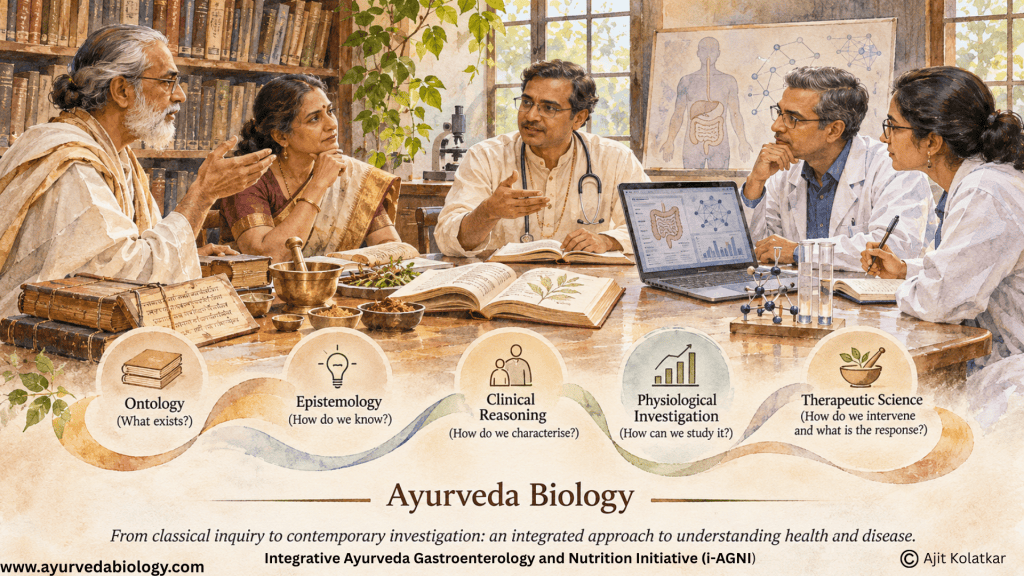
Understanding What We Are Trying to Investigate: The Ontological Question
Ontology concerns the nature of what exists, the categories through which reality is understood, and the relationships between them. In medicine, ontology influences what we recognize as health, disease, physiological function, pathological disturbance and the individual experiencing these processes. Modern biomedicine has developed increasingly sophisticated ways of describing biological reality through anatomy, cellular physiology, molecular pathways, genetics, biochemical processes and interactions between organ systems. These approaches have transformed our ability to diagnose, investigate and treat disease. Ayurveda approaches biological reality through a different conceptual organization. Concepts such as Dosha, Dhatu, Mala, Agni, Srotas, Prakriti, Vikriti and Samprapti provide a framework for describing physiological organization, individual characteristics, disturbances in function and the evolution of disease.
These are not simply alternative names for organs, tissues, molecules or biochemical pathways. They belong to a knowledge system in which health and disease are examined through relationships between the individual, physiological function, environmental influences, behaviour, and the processes through which disturbances arise and progress.
For example, Agni occupies a central position in Ayurvedic explanations of digestion, transformation and nourishment. Its significance cannot be adequately captured by equating it with gastric acid secretion, pancreatic enzymes, metabolic rate or mitochondrial function. Each of these may represent a physiological domain relevant to a particular research question, but none independently establishes the biological identity of Agni. Similarly, Ama should not automatically be equated with endotoxin, inflammatory cytokines, abnormal microbial metabolites or any single biochemical substance. Such measurements may contribute to investigating hypotheses associated with Ama, including those involving complex molecular interactions, secretomes and interactomes, but they cannot substitute for establishing what the concept means within Ayurvedic clinical reasoning. The same concern applies to Dosha, Srotas, Koshtha and other classical constructs.
This is where ontology becomes important. Before attempting to measure something, we must be clear about what we believe we are investigating, how that phenomenon is characterized within its original knowledge system, and whether the proposed measurement adequately represents the question being asked. A rigorous Ayurveda Biology must therefore begin by examining the conceptual foundations of Ayurveda rather than assuming that contemporary biological categories can fully accommodate them.
How Does Ayurveda Establish Knowledge? The Epistemological Question
If ontology helps us clarify what is being investigated, epistemology addresses how knowledge about that phenomenon is acquired, interpreted and justified. This is particularly relevant to Ayurveda because classical medical knowledge was not organized merely as a collection of descriptions of diseases and treatments. It developed within broader Indian traditions of philosophical inquiry, observation, inference, reasoning and systematic examination. An important illustration appears in Charaka Samhita, Sūtrasthāna 11/17, where four approaches to the examination of knowledge are discussed: Āptopadeśa, Pratyakṣa, Anumāna and Yukti.
द्विविधमेव खलु सर्वं सच्चासच्च; तस्य चतुर्विधा परीक्षा- आप्तोपदेशः, प्रत्यक्षम्, अनुमानं, युक्तिश्चेति॥ Ca. Su 11/17
The subject of inquiry is examined through four approaches: authoritative testimony, direct perception, inference and Yukti, or reasoned consideration of contributing factors.
In Vimānasthāna 4/3–5, however, the discussion is directed specifically towards understanding the distinguishing characteristics of disease, and three approaches are described: Āptopadeśa, Pratyakṣa and Anumāna. Yukti is not separately enumerated in this clinical context, being incorporated into the process of reasoning and inference. This is of importance because it reminds us that classical discussions of knowledge must be interpreted within their specific textual and clinical contexts rather than assembled into a single generalized framework.
Āptopadeśa concerns knowledge communicated through reliable and authoritative sources. Within Ayurveda, classical descriptions provide an essential foundation for understanding concepts, clinical characteristics and therapeutic principles. However, the authority of a classical statement and its independent validation through contemporary scientific methods represent different questions, and both must be considered appropriately.
Pratyakṣa refers to direct perception through the senses and mind. In clinical practice, this includes observations obtained through examination of the patient and the manifestations of physiological or pathological processes.
Anumāna involves inference, where knowledge of a phenomenon is developed from observations through reasoned relationships between what is perceived and what is inferred. This is particularly relevant in medicine because many important biological processes cannot be directly observed during routine clinical examination, yet their presence or disturbance may be inferred from characteristic manifestations.
Yukti deserves particular attention in the context of systems thinking. In the Charaka Samhita, Sūtrasthāna 11, Yukti is discussed in relation to reasoning about outcomes arising through the conjunction of multiple contributing factors. This provides an interesting point of dialogue with contemporary investigations of multifactorial biological processes, although Yukti should not be treated as historically or methodologically identical to systems biology.
What emerges from these discussions is an emphasis on the relationship between knowledge, observation, inference and reasoned interpretation. The classical text also cautions against relying on incomplete knowledge of a phenomenon. In Vimānasthāna 4/5, the importance of examining disease through the relevant approaches to knowledge is emphasized, rather than attempting to comprehend the whole through only one aspect.
न हि ज्ञानावयवेन कृत्स्ने ज्ञेये ज्ञानमुत्पद्यते। Ca Vi 4/5
Knowledge of the whole cannot be obtained through knowledge of only one of its parts.
This has considerable relevance to contemporary scientific reasoning. What has actually been observed? What is being inferred? What evidence supports the inference? How reliable is the source of knowledge? Could other factors explain the observation? Under what conditions should a conclusion be accepted, revised or withheld?
These questions become especially important when investigating complex biological systems, where a clinical manifestation may arise from several interacting mechanisms and where similar symptoms may occur through different physiological disturbances.
Ayurveda as a Framework for Clinical Characterisation
One of the important features of Ayurvedic clinical reasoning is its attention to the individual and the circumstances in which health and disease are expressed. A particularly useful illustration is the Daśavidha Ātura Parīkṣā described in the Charaka Samhita, Vimānasthāna 8.94. The text identifies ten dimensions of patient examination, including Prakriti, Vikriti, Sara, Samhanana, Pramana, Satmya, Sattva, Aharashakti, Vyayamashakti and Vaya.
तस्मादातुरं परीक्षेत प्रकृतितश्च, विकृतितश्च, सारतश्च, संहननतश्च, प्रमाणतश्च, सात्म्यतश्च, सत्त्वतश्च, आहारशक्तितश्च, व्यायामशक्तितश्च, वयस्तश्चेति, बलप्रमाणविशेषग्रहणहेतोः॥ Ca Vi 8/94
The patient should be examined through constitution, morbidity, tissue excellence, bodily compactness, measurements, suitability, mental strength, capacity for food intake and digestion, exercise capacity and age, to assess the individual’s strength.
These dimensions extend clinical assessment beyond the immediate manifestation of disease and include constitutional characteristics, morbidity, bodily characteristics, suitability or habituation, psychological attributes, capacity for food intake and digestion, physical capacity and age.
Importantly, the classical purpose of this examination is not simply to assign individuals to categories, but to assess the patient in relation to strength, morbidity and the appropriate application of treatment. Ayurvedic clinical characterization is not merely descriptive. It contributes to clinical judgment, prognosis and therapeutic decision-making. Similarly, the broader framework of Nidāna Pañcaka examines disease through causative factors, preceding manifestations, clinical features, therapeutic or diagnostic responses, and the process of pathogenesis. These dimensions help organize clinical information within an Ayurvedic understanding of disease rather than treating symptoms as isolated observations.
Further, these approaches raise an important possibility especially in terms of Ayurveda Biology. Could structured Ayurvedic clinical assessments identify recurring patterns of physiological behaviour, disease susceptibility or therapeutic response that deserve independent scientific investigation? The answer cannot be assumed, however, the question itself provides a meaningful starting point for research.
From Classical Clinical Characterisation to a Phenotype
A phenotype is generally understood as an observable set of characteristics arising from interactions between biological factors and the environment. In contemporary medicine, phenotyping increasingly extends beyond physical appearance to include physiological measurements, biochemical profiles, functional characteristics and longitudinal patterns of response. This creates an opportunity for Ayurveda Biology, provided that the concept of phenotype is used carefully. Ayurvedic clinical classifications may offer a starting point for identifying patterns that deserve systematic investigation. However, the existence of a classical category does not automatically establish that it represents a distinct, reproducible biological phenotype.
Consider Koshtha, which is traditionally characterized through categories such as Mridu, Madhyama and Krura and has practical significance in assessing gastrointestinal characteristics and responses to therapeutic interventions. A contemporary investigator might be tempted to interpret these categories as corresponding directly to rapid, normal and slow intestinal transit. Such a hypothesis may appear attractive because transit can be measured, but the availability of a measurement does not establish that it adequately represents the classical construct.
A more appropriate starting point would be to examine how Koshtha is characterized within Ayurvedic clinical practice, what observations contribute to its assessment, whether different practitioners can identify its categories consistently, and whether these characteristics remain relatively stable or change under different physiological conditions. Only after these questions have been addressed should we investigate their possible relationships with gastrointestinal transit, motility, evacuation characteristics, meal tolerance, visceral sensitivity and other physiological domains.
The resulting investigation should not attempt to prove that Koshtha is equivalent to intestinal transit. It should examine whether classical Koshtha characterization identifies meaningful patterns of gastrointestinal physiology that are reproducible, distinguishable and potentially useful in predicting clinical responses. This may help us understand the difference between assigning a modern meaning to a classical concept and developing a scientific investigation originating from that concept.
Biological Individuality and the Importance of Physiological State
Another important issue in clinical phenotyping is the distinction between relatively stable individual characteristics and changes associated with the prevailing physiological state. Living systems are continuously influenced by food, sleep, stress, illness, medication, environmental conditions and previous biological experiences. Consequently, an individual’s physiological response at one point in time may differ substantially from the response observed under other circumstances. This is evident especially in gastrointestinal physiology, where motility, secretion, visceral sensitivity, microbial metabolism and neuroendocrine signaling can vary with both immediate stimuli and the condition of the system receiving them.
Ayurvedic clinical reasoning recognizes the importance of individual characteristics as well as the circumstances influencing the present condition. Prakriti and Vikriti, for example, contribute different dimensions to the assessment of the individual, while other constructs such as Agni, Koshtha and Dosha help organize particular aspects of clinical interpretation. However, we should be careful not to assume that Prakriti is identical to a stable biological trait or that Vikriti corresponds exactly to a measurable state variable. These are possible areas of conceptual dialogue, not established equivalences.
The scientific challenge is to determine which observed characteristics remain consistent, which vary over time, and whether their interaction provides meaningful information about health, disease susceptibility or therapeutic response. Repeated measurements become particularly important in this context. A single observation may capture the patient during a temporary disturbance, whereas longitudinal assessment can help distinguish recurring patterns from transient fluctuations. Such an approach also connects with contemporary systems biology, where physiological behaviour is examined in relation to adaptation, feedback, compensation, nonlinear responses and changes in system state.
Therefore the relevance lies in whether its clinical frameworks can generate meaningful questions about these processes, rather than in assuming that the two knowledge systems already describe identical phenomena.
What Would Constitute Scientific Validation?
The scientific investigation of Ayurvedic constructs requires more than identifying correlations between classical categories and modern biomarkers. A biomarker may differ between two clinically characterized groups without demonstrating that it represents the underlying construct. Such an association could reflect age, diet, medication, disease severity, environmental exposure or other confounding factors.
But prior to that several questions may therefore need to be addressed. Can the clinical construct be characterized consistently? Do independent observers arrive at similar assessments? Does the characterization remain reproducible under comparable conditions? Are there meaningful differences between groups when independently assessed physiological domains are examined? Do those differences persist after relevant confounders are considered? Of equal importance is whether the proposed phenotype predicts something clinically useful. Can it identify susceptibility to a particular disturbance, distinguish different patterns of disease evolution or predict responses to dietary and therapeutic interventions?
These questions require appropriately designed observational studies, longitudinal assessments, controlled interventions and, where necessary, experimental models.
It is also important to distinguish different levels of validation. Agreement between observers establishes something about the reliability of an assessment, but does not necessarily establish that the intended construct has been adequately captured. Similarly, an association with a biomarker does not demonstrate causality, while a predictive relationship does not by itself establish the mechanism responsible for that prediction. Systems biology adds another dimension by allowing multiple measurements to be examined together. Rather than searching for one biomarker that represents a complex clinical construct, researchers can investigate whether patterns across physiological, metabolic, microbial, immune and neuroendocrine domains provide a more informative description of a biological state.
Such approaches may involve multivariate analysis, network modeling, multi-omics integration and computational phenotyping. However, greater analytical complexity does not automatically produce better science. A sophisticated computational model cannot compensate for poorly defined clinical categories, unreliable measurements or assumptions that have not been critically examined….…Garbage in is Garbage Out!!!
An investigation may support a proposed relationship, suggest that it requires modification or fail to demonstrate the expected association. All three outcomes are scientifically meaningful, provided that the research question and methods are sufficiently clear. The purpose of validation is not to confirm an interpretation that has already been accepted, but to determine whether the proposed interpretation is supported by evidence.
Why This Matters Beyond Gastroenterology
Although much of our discussion has emerged from gastrointestinal physiology, the implications extend well beyond the gut. Non-communicable diseases such as obesity, diabetes, metabolic disorders, cardiovascular disease and chronic inflammatory conditions develop through interactions involving genetics, metabolism, immunity, environment, behaviour and physiological adaptation. These conditions often evolve gradually, with changes in biological regulation occurring before established clinical disease becomes apparent. Their progression is rarely explained by a single pathway, and individuals with apparently similar diagnoses may differ substantially in their underlying physiological characteristics and responses to treatment.
Ayurvedic concepts relating to individual constitution, functional disturbance, adaptation and disease progression may offer research questions relevant to these challenges. For example, Shatkriyakala provides a classical framework for examining the progression of pathological processes, while Agni and Ama raise questions concerning transformation, functional disturbance and the persistence of abnormal physiological states. Their contemporary scientific relevance, however, must be established through investigation rather than assumed from conceptual resemblance. There are multiple other constructs and principles within Ayurvedic sciences that call for a structured investigation program.
This is where Ayurveda Biology has an opportunity to contribute. It can encourage researchers to formulate questions that may not arise naturally from organ-based or molecularly focused approaches, while using contemporary scientific methods to determine whether those questions lead to new knowledge.
The Need for a Disciplined Translational Framework
If Ayurveda Biology is to develop as a serious scientific discipline, it requires a methodological framework that allows researchers to move between classical knowledge, clinical observation and contemporary investigation without confusing their respective roles. Such a framework should begin with a careful examination of the classical concept, including its textual foundations, clinical context and relationships with other Ayurvedic constructs. It should then identify what can be observed in clinical practice, how those observations may be characterized consistently, and which specific hypotheses are suitable for investigation. Contemporary physiology, biomarkers, experimental biology and computational methods can subsequently be used to examine those hypotheses, with the results interpreted according to the evidence they actually provide.
An equally important dimension of Ayurveda Biology concerns Chikitsa, the principles and practice of Ayurvedic therapeutics. Classical Ayurvedic reasoning extends beyond identifying the nature of a physiological disturbance or characterising the individual. It also informs the selection of interventions, their timing, intensity, sequencing and adaptation according to the patient’s condition. Therapeutic principles such as Langhana, Brimhana, Snehana, Shodhana, Shamana, Deepana and Pachana therefore provide another important starting point for scientific investigation. Rather than examining these interventions only in terms of their eventual clinical outcomes, research could also investigate the reasoning behind their selection, the physiological responses they produce, the conditions under which they may be effective, and the factors contributing to individual differences in therapeutic response.
Importantly, therapeutic investigation need not follow physiological characterisation as a separate or final step. Observations arising from Chikitsa may themselves generate hypotheses about biological regulation, adaptation and disease processes. For example, the classical recognition of Koshtha-dependent differences in response to Snehana and Virechana raises questions about individual therapeutic sensitivity, response thresholds and the time required to achieve particular effects. Such observations could guide prospective investigations involving structured Ayurvedic assessments, independently measured physiological responses and clearly defined clinical outcomes. The objective should be to investigate their rationale, mechanisms, safety, effectiveness and clinical relevance through appropriate scientific methods.
This does not require us to choose between Ayurveda and modern science, nor does it require us to assume that their conceptual frameworks are interchangeable. Rather, it requires intellectual clarity about what each knowledge system contributes and methodological discipline in determining which claims can be supported through scientific investigation. The implications extend into education as well. Students and researchers entering Ayurveda Biology need more than familiarity with classical texts or contemporary laboratory techniques in isolation. They require training in Ayurvedic philosophy and clinical reasoning, research methodology, physiology, systems biology, biostatistics, experimental design and the interpretation of complex biological data.
Also the ability to distinguish conceptual interpretation from scientific evidence, recognize the limitations of particular methods and remain open to findings that challenge an initial hypothesis. A structured Ayurveda Biology curriculum should cultivate precisely this intellectual flexibility, allowing researchers to work across knowledge systems while remaining rigorous about the methods and limitations of each.
A Direction Forward
The development of Ayurveda Biology should not begin with an attempt to demonstrate that every Ayurvedic concept already exists somewhere within contemporary biomedical science. Such an approach risks narrowing the very knowledge system we are attempting to investigate. A more productive direction is to begin with the questions Ayurveda asks about the individual, physiological function, disease evolution and the principles governing Chikitsa, including therapeutic selection, intervention and individual response, and then examine how these questions can be investigated through appropriately designed scientific studies. Moreover, this approach may help us identify shared principles across these knowledge systems and gradually develop a common conceptual grammar through which we can better understand biological function, health and disease, while respecting the distinct foundations of each. This would require a clear understanding of Ayurvedic ontology, a disciplined approach to epistemology and a willingness to subject proposed biological interpretations to critical evaluation. It also requires recognizing that meaningful scientific investigation may support some hypotheses, modify others and challenge assumptions that initially appeared plausible.
In the next article, I will take Koshtha as a practical example of this approach. Rather than assuming that Mridu, Madhyama and Krura Koshtha represent predefined patterns of intestinal transit, we will examine how these categories are understood within Ayurveda, how they may be characterized clinically, and whether they can be investigated as reproducible gastrointestinal phenotypes using contemporary physiological methods.
The larger objective is not simply to make Ayurveda measurable. It is to determine whether questions originating within Ayurvedic knowledge can contribute to a deeper and scientifically defensible understanding of biological individuality, regulation and disease.
Ayurveda Biology must begin with the integrity of the question, not the convenience of the measurement.


Leave a Reply